
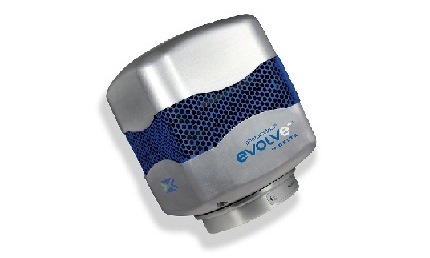
Photometrics has launched the industry’s fastest and most sensitive camera for super-resolution imaging.
For super-resolution experiments to be successful, researchers need a camera capable of collecting data at extremely high frame rates.
While the optical components for super-resolution imaging have improved, camera technology remains limited by its speed, creating a bottleneck.
Equipped with a sensor running at 20MHz that captures images at 62.5 frames per second and less than 1e- read noise (using EM gain), the Evolve 512 Delta makes super-resolution imaging much more productive and efficient.
The Evolve 512 Delta was specifically designed for super-resolution applications such as STORM, PALM and GSD.
The camera is also suited for a range of other applications including SMF and Tracking, Live-cell Spinning Disk Confocal, SPIM, Intrinsic Imaging, FCWS, TIRF, FRET and FRAP.
Evolve 512 Delta is the only camera to offer these features and benefits:
20MHz sensor
62.5 frames per second
>90% quantum efficiency
Quantitative performance
Photometrics is providing existing Evolve 512 customers with an option to upgrade their legacy cameras to the performance level of the Evolve 512 Delta, extending the life of their investment. The upgrade package will be available through the company’s global service centers.


