
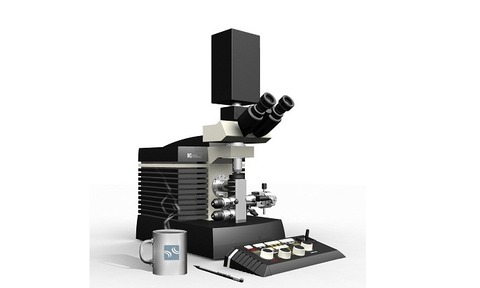
Delong America has unveiled the Tilt Holder and AFM Tip Holder for the LVEM5 benchtop electron microscope.
The LVEM5 is an electron microscope designed to combine advanced imaging with benchtop convenience.
According to the company, the LVEM5 is the smallest multi-mode desktop electron microscope on the market today.
Delong has announced two new accessories for LVEM5- the Tilt Holder and AFM Tip Holder.
Tilt Holder
The tilt holder is capable of ±15° of tilt, or a total of 30° of tilt.
This holder is compatible with all imaging modes (TEM, SEM & STEM). It can be used for Electron Tomography or Photogrammetry to obtain detailed 3D structures from 2D images.
AFM Tip Holder
Atomic Force Microscopy (AFM) relies on a cantilever with a sharp tip (probe) that is used to scan the surface of a sample.
AFM tips generally have a radius of curvature of around a few nanometers.
With the addition of the new AFM tip Holder, The LVEM5 is now capable of accepting AFM tips as samples.
Tip shape and sharpness can easily be measured in both TEM and SEM modes. This versatility, paired with rapid sample exchange, is a strong advantage for quality assurance inspection associated with the production of AFM probes.


